
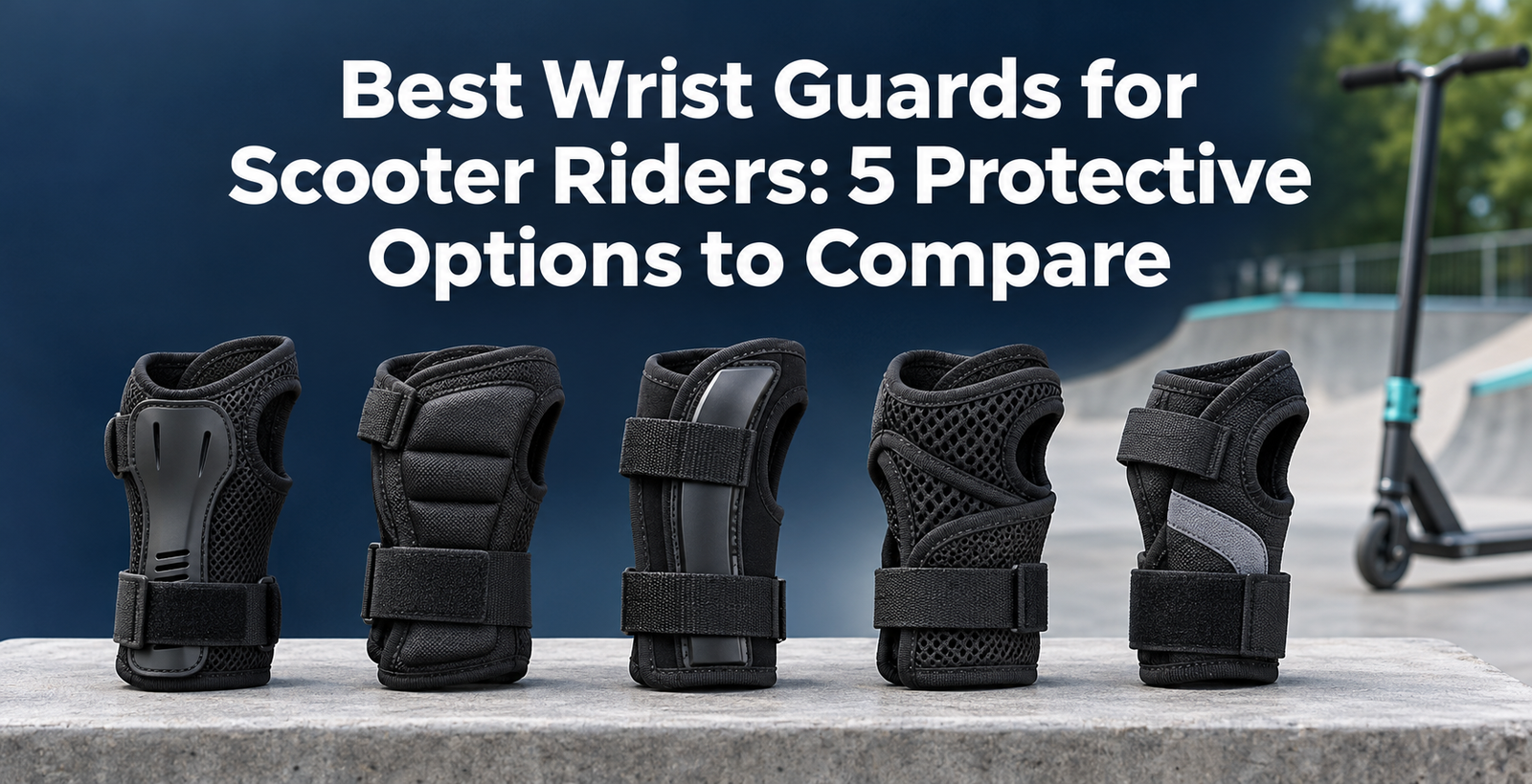
Choosing wrist guards involves more than finding a comfortable size. Scooter riders also need to consider how a guard affects their hold on the handlebars and their access to brake or throttle controls.
That makes this a different buying decision from choosing a wrist brace for everyday support. This guide compares action-sport wrist guards by their published construction, closures, and fit features.
Check grip compatibility first. Razor’s A125 manual specifically tells parents to evaluate whether wrist guards impair their child’s ability to hold the handlebars. Follow the instructions for your own scooter and the guards you intend to use.
The five products below are marketed mainly for skating or other action sports. Their inclusion does not establish scooter-specific testing or suitability for every scooter. This comparison uses manufacturer information rather than hands-on impact testing.
Amazon links open model-specific search results. Check the exact model, size, seller, package contents, and return terms before ordering.
Quick Comparison
| Product | Published construction | Main reason to compare |
|---|---|---|
| Triple Eight Wristsaver | Front and rear ABS splints, EVA cushioning, stretch mesh | Conventional splinted design |
| Triple Eight Wristsaver II | Slide-on body, single strap, ABS splints | Different fastening method |
| 187 Killer Pads Wrist Guard | Angled profile, reinforced palm and thumb opening | Fit and reinforced contact areas |
| 187 Killer Pads Pro Wrist Guard | Spoon-shaped splint, double wrist straps | Different splint and adjustment arrangement |
| ENNUI City Wristguard | Aluminum splints, padded SBR sleeve, leather sections | Alternative materials and sleeve construction |
These are construction differences, not a ranking of injury prevention or scooter compatibility. Triple 8
1. Triple Eight Wristsaver Wrist Guards
A conventional splinted option
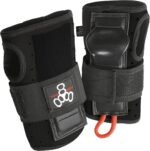 Triple Eight describes the original Wristsaver with molded ABS splints on the palm and back of the wrist. EVA foam provides cushioning between the splints and wrist, while four-way stretch nylon mesh forms the body. Its listed activities include skateboarding, inline skating, and roller derby.
For a scooter rider, the palm splint is an important area to assess. Check where it sits against your particular handlebar grip rather than judging fit only with an open hand.
Triple Eight’s sizing guidance uses hand circumference at the knuckles. Measure as directed instead of assuming your usual glove size will match.
Why compare it: Front-and-back splints, cushioning, and stretch-mesh construction.
What to check: Intended use, hand measurement, palm contact on the bars, and access to controls.
2. Triple Eight Wristsaver II Wrist Guards
A slide-on alternative with a single strap
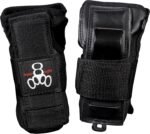 The Wristsaver II uses a slide-on body and a single fastening strap. Triple Eight also lists front and rear ABS splints, EVA cushioning, and four-way stretch nylon mesh. The model is marketed for skateboarding, inline skating, and roller derby.
This is worth comparing if putting on and removing equipment is an important practical concern. A convenient fastening system still needs to hold the guard in its intended position.
During a fitting trial permitted by the seller’s return policy, inspect the thumb opening and palm while holding the handlebars. Check whether your hand can close around the grip without the guard shifting or creating an awkward pressure point.
Why compare it: A different fastening method within the Wristsaver range.
What to check: Sleeve fit, strap adjustment, palm-splint position, and the manufacturer’s instructions.
3. 187 Killer Pads Wrist Guard
 An option with reinforced contact areas
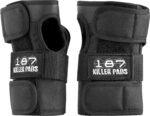
The standard 187 Killer Pads Wrist Guard has an angled profile, padded interior, reinforced thumb opening and palm, and ballistic nylon with industrial-weight stitching. The manufacturer also describes an extra-thick splint at the base of the hand.
187’s FAQ identifies its standard wrist guard as an open-back design with three straps. That provides a different adjustment layout from the slide-on Wristsaver II.
Check each strap’s position after fitting. A guard may seem comfortable with your fingers extended but feel different once your hand wraps around a cylindrical grip.
Why compare it: Reinforced palm and thumb areas with a three-strap adjustment layout.
What to check: Exact model, strap engagement, splint placement, and handlebar compatibility.
4. 187 Killer Pads Pro Wrist Guard
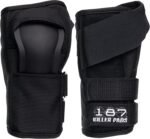 A different splint shape and strap arrangement
The Pro Wrist Guard uses what 187 calls a spoon-shaped splint. Its listed features also include double wrist straps, a padded interior, and a design intended to allow finger movement.
These differences make it worth comparing with the standard model. However, “Pro” should not be treated as proof that it provides better results for scooter riders. Product descriptions alone do not establish comparative protection.
Look closely at how the splint and padding interact with your grip. Free finger movement does not, by itself, confirm that your whole hand can comfortably hold the bars or operate a lever.
Why compare it: Spoon-shaped splint construction and double wrist straps.
What to check: Hand closure, palm contact, model-specific sizing, and intended uses.
5. ENNUI City Wristguard
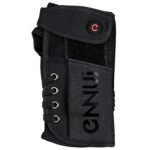 An aluminum-splinted option with a padded sleeve
Powerslide lists the ENNUI City Wristguard with aluminum palm and rear splints, a padded SBR sleeve, leather sections, and hook-and-loop closures. The current product page identifies model 920017 and states compliance with EN 14120.
That published compliance should not be interpreted as confirmation of suitability for every scooter, speed, or control arrangement. Ask for the documentation applicable to the exact version being sold.
Listings may use names such as City Wristguard or City Brace. Confirm the model and version instead of assuming similarly named products have identical construction.
Why compare it: Aluminum splints and a sleeve-based design.
What to check: Exact version, sizing, compliance documentation, cleaning requirements, and grip compatibility.
Amazon.com: City Wristguard : Health & Household
Wrist Guards and Wrist Braces: Separate Buying Decisions
For this article, the relevant category is protective equipment marketed for skating or action sports. A support sold for typing, sleep, pain, or recovery should not be assumed to serve the same purpose.
Product names can overlap. An action-sport guard may even include “brace” in its name. Read the intended-use instructions and construction details rather than relying on the label.
If you are choosing equipment because of an existing injury, get individual advice about returning to riding. AAOS advises against scooter riding when an injury affects standing, balance, holding the handles, or maneuvering the scooter.
How to Choose Wrist Guards for Scooter Riding
Start With Your Scooter’s Instructions
 Identify whether you use a non-electric kick scooter, stunt scooter, or electric scooter. Review its manual for protective-equipment guidance.
Handlebar shape, grip diameter, and control layout are useful details to provide when asking a guard manufacturer about compatibility. Keep its response and fitting instructions with your equipment records.
Measure Using the Exact Size Chart
Follow the measurement method for the model you intend to order. Check where the tape should sit and what the manufacturer recommends for measurements between sizes.
Avoid choosing a tighter size simply to compensate for a poorly positioned splint. Keep the packaging until you have completed any fitting checks allowed by the return policy.
Check Grip and Control Access
 With the scooter stationary and supported, assess the intended fit on the actual handlebars. Keep an electric scooter powered off during this check.
Consider these questions:
- Can your hand close around the grip?
- Does the palm splint sit awkwardly against it?
- Can you reach the brake lever or throttle?
- Do straps or padding shift when you change hand position?
A stationary check can reveal an obvious mismatch, but it cannot establish riding safety. Equipment that interferes with holding, steering, or operating controls needs to be resolved before riding.
Compare Documentation and Intended Uses
Terms such as “professional,” “heavy duty,” and “maximum protection” do not provide a common comparison scale.
Ask which standard, if any, applies to the exact model and what limitations its instructions state. Do not assume a standard or recommendation for one activity establishes suitability for another.
Include Cleaning and Replacement Costs
 Check how to clean the fabric, padding, straps, and splints. Confirm whether components can be removed and whether replacements are available.
Follow the manufacturer’s inspection and replacement instructions after damage or an impact. Compare the complete price for a pair, delivery, and any required accessories.
Also verify that the listing includes both left and right guards in the size you need.
Consider Your Complete Riding Setup
Wrist guards are one equipment decision. The CPSC’s scooter safety guidance also recommends an appropriate helmet and knee and elbow pads. Follow the guidance applicable to your scooter and activity.
Which Wrist Guards Should You Compare First?
Compare the Triple Eight Wristsaver and standard 187 Killer Pads Wrist Guard for their conventional construction. Consider the Wristsaver II if its slide-on fastening method appeals.
The 187 Pro offers another splint and strap arrangement, while the ENNUI City Wristguard provides an aluminum-splinted alternative.
Choose only after checking intended use, fit, and compatibility with your scooter’s grip and controls. None of these five is a universal scooter recommendation.
You May Also Like

Best Folding Adult Kick Scoo ...
November 12, 2026
Best Electric Scooters for S ...
November 2, 2026
Best Lightweight Electric Sc ...
October 30, 2026
Leave a Comment